
Just as the public sector serves an important role in the healthcare system, the private sector is just as needed. The private sector fills in gaps that the government is unable to provide due to the growing need of services. Non-profit organizations and non-governmental organizations (NGOs) help strengthen health systems and greatly contribute to ending preventable maternal deaths. There is an emerging understanding that building a strong health delivery system requires multi-sectoral collaboration between non-profits and NGOs and government agencies. This innovative approach values how organizations and their donors can engage key stakeholders, involve the community, monitor and use data to inform decisions, create programs, and partner with policymakers (Story et al., 2017). Some influential and important organizations that are working to decrease maternal morbidity and mortality will be discussed below.
March of Dimes:
https://www.marchofdimes.org/
March of Dimes leads the fight for the health of all moms and babies. They are working to create health equity and remove disparities, no matter the age, socio-economic background, or demographics of the mother. They advocate for policies to support mothers and their families and pioneer research to find solutions for the greatest health threats. They utilize their access to tools, technology, and knowledge to educate health professionals, support lifesaving research, and guide mothers through every stage of pregnancy.
March for Moms:
https://marchformoms.org/
March for Moms is an advocacy group who raises awareness to improve the health and well-being of mothers. They work year around with healthcare providers, policymakers, and families to advocate for improvements in healthcare practices and better access to healthcare. One time a year they gather at the U.S. Capitol in Washington D.C. to bring together diverse individuals across the country who support the health of mothers and their families.
National Birth Equity Collaborative:
https://birthequity.org/
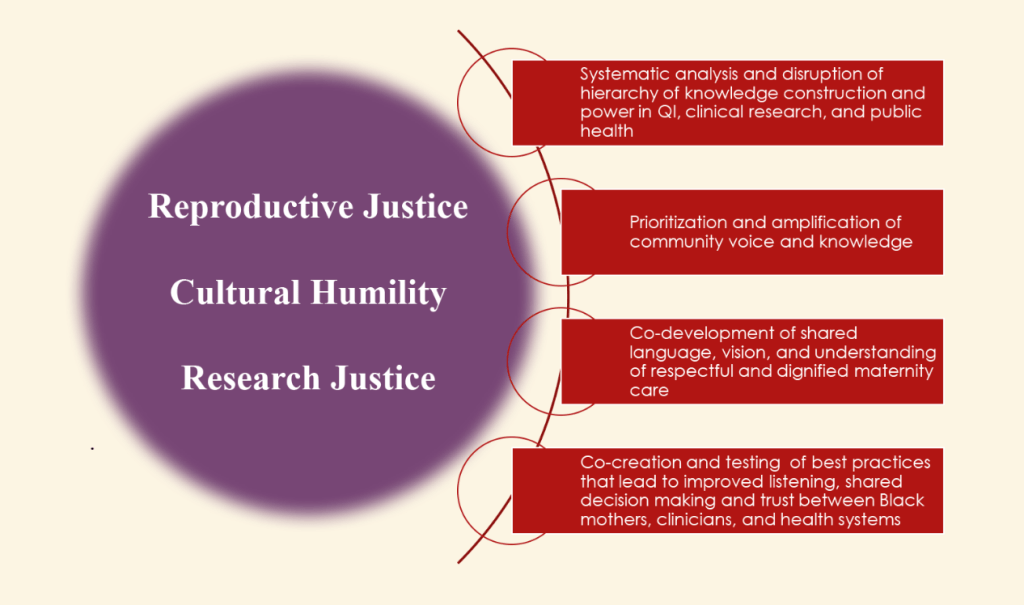
The National Birth Equity Collaborative (NBEC) works in partnership with the National Collaborative for Health Equity to create solutions to improve Black maternal and infant health through training, policy advocacy, research, and community-centered collaboration. Recognizing the need for providers and systems to know the experiences of patients, they developed a community-informed theoretical model to create and test a participatory patient-reported experience metric (PREM) of mistreatment and discrimination in childbirth. The PREM will be utilized in systems accountability, quality improvement, patient advocacy, and interprofessional education. NBEC works with organizations, communities, and stakeholders to develop and implement strategies to achieve health equity.
American College of Obstetricians and Gynecologists
The American College of Obstetricians and Gynecologists (ACOG) is the premier membership organization for obstetrician–gynecologists and providers of women’s health care. They facilitate programs and initiatives aimed at improving women’s health and advocate on the behalf of members and patients. ACOG is the lead partner in The Alliance for Innovation on Maternal Health (AIM) Program. AIM is the national alliance program working to reduce maternal mortality and severe maternal morbidity that was discussed in the last blog post.

References
American College of Obstetricians and Gynecologists. (2020). About. Retrieved from https://www.acog.org/about
March for Moms. (2019). Who we are. Retrieved from https://marchformoms.org/who-we-are/
March of Dimes. (2020). Who we are. Retrieved from https://www.marchofdimes.org/mission/who-we-are.aspx
National Birth Equity Collaborative. (2020). What we do. Retrieved from https://birthequity.org/what-we-do/mothers-voices-driving-birth-equity/
Story, W. T., LeBan, K., Altobelli, L. C., Gebrian, B., Hossain, J., Lewis, J., …Weiss, J. (2017). Institutionalizing community-focused maternal, newborn, and child health strategies to strengthen health systems: A new framework for the Sustainable Development Goal era. Global Health, 13(37), 1-13. doi: 10.1186/s12992-017-0259-z


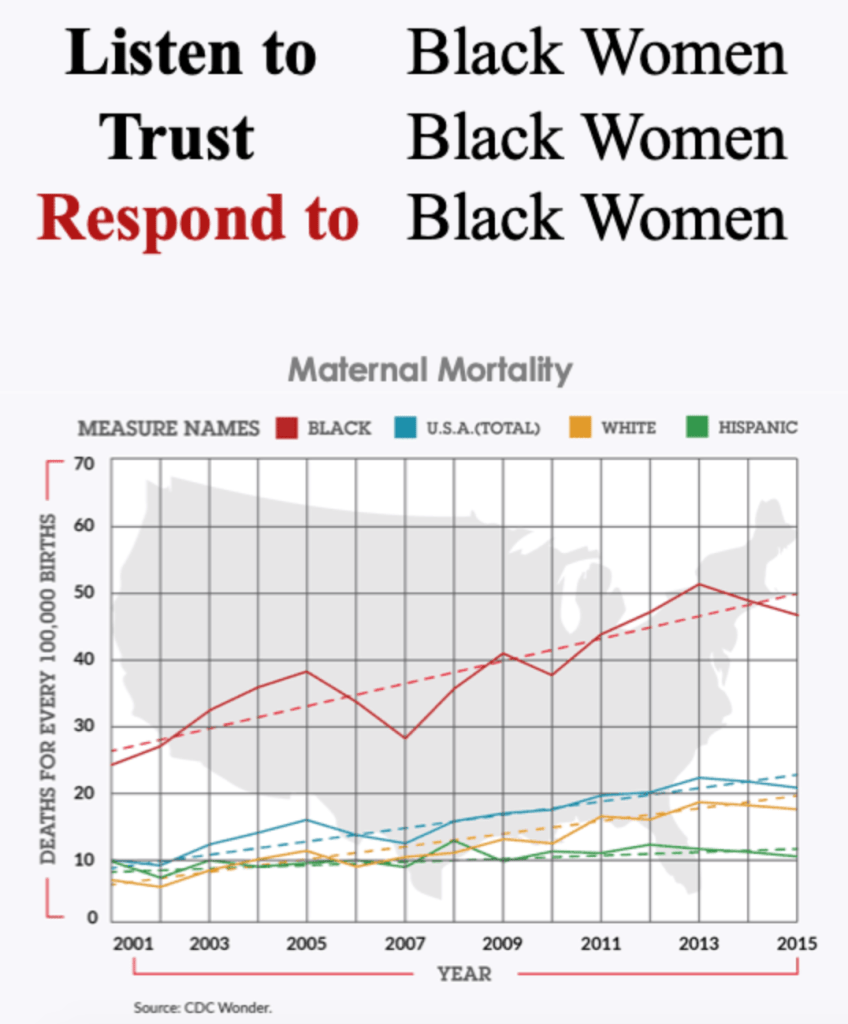
I enjoyed reading your post about the national private organizations supporting issues of maternal morbidity. The graph on maternal morbidity of black women compared to the rest of the U.S. population helps identify an important population requiring more attention from healthcare providers.
As I mentioned in my last comment, I am continually trying to make sense of the U.S. maternal morbidity rates. I’ve come across multiple articles that suggest health of women as they go into their pregnancy is an issue. According to Amnesty International, an American woman is three to five times as likely to die in childbirth than women in Spain, Germany and Greece (Moszynski, 2010). The same article mentions that black women are a higher risk population, and the author references the lack of healthcare resources available to this population as being a primary reason. Do you agree that health of women as they enter pregnancy is a factor? Also, have you seen details about the prenatal programs available to women in Spain, Germany or Greece?
Reference
Moszynski, P. (2010). US maternal mortality rates double in 20 years, Amnesty report says. British Medical Journal, 340(7750), 782. Retrieved from http://www.jstor.org/stable/40702917
LikeLike