The Centers for Disease Control and Prevention (CDC) (2020) initiated a national surveillance of pregnancy-related deaths in 1986 to understand the causes of maternal mortality in the United States (U.S.). Every year the CDC requests all 52 states and Washington D.C. send copies of death certificates for all women who died during pregnancy or during up to one year postpartum, associated live birth or fetal death certificates, and additional data when available. Medically trained epidemiologists determine the cause and time of death related to pregnancy and it is then coded in the system. The data is analyzed by the CDC and the information is released periodically through peer-reviewed literature, the CDC’s Morbidity and Mortality Weekly Reports, and the CDC website. This information is used to better understand the causes of pregnancy-related mortality and what actions need to be taken to prevent them. Advancements in technology and computerized data linkages by state has improved the identification of pregnancy-related deaths. Though errors in reported pregnancy status on death certificates have been identified, potentially leading to overestimation of maternal mortality numbers (CDC, 2020).
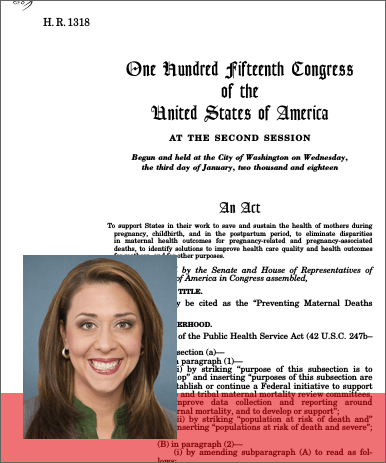
Jaime Herrera Butler (R), Sponsor. Representative for Washington’s 3rd congressional district.
To better understand maternal complications, discover errors in the reporting system, and identify solutions, new legislation was established. In my first blog post I introduced you to H.R. 1318: Preventing Maternal Deaths Act that was signed into law in December 2018. This legislation “directs the Department of Health and Human Services (HHS) to establish a program under which HHS may make grants to states for the purpose of: (1) reviewing pregnancy-related and pregnancy-associated deaths (maternal deaths); (2) establishing and sustaining a maternal mortality review committee to review relevant information; (3) ensuring that the state department of health develops a plan for ongoing health care provider education in order to improve the quality of maternal care, disseminate findings, and implement recommendations; (4) disseminating a case abstraction form to aid information collection for HHS review and preserve its uniformity; and (5) providing for the public disclosure of information included in state reports” (GovTrack, 2018). It serves to help solve the shortage of reliable data about what leads to maternal mortality in the U.S. by improving how states track and investigate the deaths of expectant and new mothers up to one year postpartum. Reviewing data is essential to develop prevention efforts and quality improvement and quality control programs. The committees help to guarantee the data is organized and categorized correctly into the system, so the data is reported accurately across the nation.
Protection of Data
The mortality surveillance data are protected under the Assurance of Confidentiality. This is a formal confidentiality protection authorized under Section 308(d) of the Public Health Service Act. The protection allows CDC programs to assure individuals and institutions protect the confidentiality during data collection and maintenance of sensitive identifiable or potentially identifiable information. All data and documents in the Pregnancy Mortality Surveillance System are considered confidential materials and are safeguarded to the highest degree possible. This protection also extended to all pregnancy mortality surveillance data obtained from individual states and reporting areas (CDC, 2020).
References
Centers for Disease Control and Prevention. (2020). Pregnancy Mortality Surveillance System. Retrieved from https://www.cdc.gov/reproductivehealth/maternal-mortality/pregnancy-mortality-surveillance-system.htm
GovTrack. (2018). H.R. 1318 (115th): Preventing Maternal Deaths Act of 2018. Retrieved from https://www.govtrack.us/congress/bills/115/hr1318
 Maternal Mortality in the United States
As you consider the technology policies in place to securely track maternal mortality, did you encounter any technological innovations or opportunities designed to prevent maternal mortality? -HMR
LikeLike
Your post is of interest to me at this time, as I am in my third trimester of pregnancy and have recently been anxious about maternal and infant morbidity and mortality, particularly in regard to the current Covid-19 pandemic. Surprisingly, you mentioned the 2018 H.R. 1318 bill, preventing maternal deaths act, which allows for increased surveillance of maternal and fetal outcomes during the first year of life. As you stressed, it is imperative that this data be tracked and utilized to improve patient outcomes. The World Health Organization (2020) reported that in 2017 there were 810 women who died daily due to preventable pregnancy and childbirth. This is unacceptable and alarming. These statistics piqued my interest in local data and population outcomes.
In the United States, there are 19 maternal deaths per 100,000 live births (Central Intelligence Agency, 2017). That may not sound terribly worrisome, however when compared to other developed nations we fall far behind. For example, in France there are only 8 maternal deaths per 100,000 live births (Central Intelligence Agency, 2017). In Canada, the maternal deaths rate is 10 per 100,000 live births and in Germany it is 7 per 100,000 (Central Intelligence Agency, 2017). It is apparent that such a technologically advanced nation should not be experiencing double the maternal mortality rate of similar countries. With another election approaching, and healthcare becoming a major player in politics, I hope that some major improvements will result from this. Thank you for your informative post.
References
Central Intelligence Agency. (2017). Library: The world factbook. Retrieved from https://www.cia.gov/library/publications/the-world-factbook/geos/us.html
World Health Organization. (2020). Maternal mortality. Retrieved from https://www.who.int/news-room/fact-sheets/detail/maternal-mortality
LikeLike
Not knowing much about maternal mortality in the US and World, I enjoyed your blog posts. It is clear that American has come a long way with new technologies and innovation, but we have much further to go and a great deal of work needed in other parts of the world.
In looking further to investigate recent innovations in the fight against maternal mortality, I found an article by McCabe1 and team which looked at the cost-effectiveness of directly observing HIV-Infected pregnant women self-administer their antiretroviral therapy in their third trimester. The researchers found that by supporting the women during the observation, there were able to educate and offer counseling and support, which led to high adherence. Their study did not follow up on the impact of HIV transmission to the infant at birth but suggested further research to determine if the adherence to the medication would prevent transmission, which was their hypothesis.
Callister and Edwards2 reported on the success of the 2015 initiative, Millennium Development Goals, to reduce maternal mortality by using Sustainable Development Goals. Key leaders developed these goals across the Globe and the United Nations, which focused on poverty, reducing the spread of HIV/AIDS, primary education for birth attendants, and more, eight in total. A recommendation by the group was to implement the REACT quality and safety initiative implemented by the United States. REACT encourages providers and caregivers to Recognize, Educate, Activate, Communicate, and Treat with most current evidence-based practices available to them.
I am encouraged by what is being done and hope that your policy initiative will continue to provide resources for this vulnerable population.
Reference
2 Callister, L., & Edwards, J. (2017). Sustainable Development Goals and the Ongoing Process of Reducing Maternal Mortality. Journal of Obstetric, Gynecologic & Neonatal Nursing, 46(3), E126-E127.
1McCabe, C., Goldie, S., Fisman, D., & Loutfy, M. (2010). The Cost-Effectiveness of Directly Observed Highly-Active Antiretroviral Therapy in the Third Trimester in HIV-Infected Pregnant Women (DOT for HIV in Pregnancy). PLoS ONE, 5(4), E10154.
LikeLike
Kara, thank you for sharing quality information related to this important health topic. ACOG is working hard to get maternal mortality review committees (MMRC) in every state. Sadly, Arizona does not have one yet. States with MMRCs can participate in the innovative AIM program which uses the technology of online learning modules in combination with checklists, work plans, tool kits and links to published resources to give participating providers and hospitals evidence-based guidance to improve outcomes. Participation requires committed leadership to report back on AIM data. To date 17 states are participating. You can find out more about this program at: https://safehealthcareforeverywoman.org/aim-program-3/about-aim/
LikeLike
Kara,
Thank you for covering this important topic. It is astounding to me that maternal mortality continues to be a problem with all of our advancements in medicine. A colleague of mine died during childbirth last year. She was a physician with the knowledge and access to care that should have ensured a healthy outcome.
The majority of maternal death occurs in developing nations. New technologies have been developed to help mothers and healthcare workers in developing countries improve care and reduce maternal mortality. For an example, in South Africa, an SMS system helps mothers register their pregnancies on a national database. The mother then received regular test messages with information regarding pregnancy. Another technology, an application, Safe Delivery App is a training tool that health care workers in remote areas can access to give them instructions and training on how to care for a woman before and after childbirth and how to handle emergencies.1 Such technologies help to address the problem of access to information and care. They help bridge the gap of healthcare. However, technology can only be an adjunct to the solution of improving or eliminating maternal mortality. A host of problems have to be addressed and we should use all the tools we have at our disposal to address them, including technology.
Reference
1. Frellsen, A. C. (2016, October 2016). Tackling the age-old problem of maternal mortality through modern technology. Retrieved from https://www.devex.com/news/tackling-the-age-old-problem-of-maternal-mortality-through-modern-technology-88874
LikeLike
Kara,
I was surprised to learn that the United States has one of the highest maternal mortality rates in the developed world, with a maternal mortality of 16.9 deaths per 100,000 (CDC, 2020). According to data collected between 2008 and 2017, it was discovered that about 66% of deaths were avoidable (CDC, 2019). The most common causes of death worldwide include hemorrhaging, infection, hypertension, and difficulties with delivery (WHO, 2019). You made an excellent point in your most recent post; surveillance will help identify contributing factors of maternal mortality and how to prevent deaths. I noticed that death rates have gone up from 7.2 deaths per 100,000 in 1987 to the 16.9 per 100,000 (CDC, 2020). I wonder if the numbers have risen because surveillance has become more thorough, the population has grown, or because of the increased prevalence of co-morbidities. What are your thoughts? What do you think is the reason for the rise in maternal mortalities?
Karen
Centers for Disease Control and Prevention. (2020). Pregnancy mortality surveillance system. Retrieved from https://www.cdc.gov/reproductivehealth/maternal-mortality/pregnancy-mortality-surveillance-system.htm
Centers for Disease Control and Prevention. (2019). Pregnancy-related deaths: Data from 14 U.S. Maternal Mortality Review Committees, 2008 – 2017. Retrieved from https://www.cdc.gov/reproductivehealth/maternal-mortality/erase-mm/mmr-data-brief.html
World Health Organization. (2019). Maternal mortality. Retrieved from https://www.who.int/news-room/fact-sheets/detail/maternal-mortality
LikeLike
Maternal Mortality data is important, and its protection is as well. This topic is very near and dear to me as a Native American person, as we are a matriarchal People. This past year I had the opportunity to work with the Arizona Maternal Review program, before they requested for a team of experts to create a task force on the subject. It was interesting and overbearing to hear the statistics. Maternal deaths rates are higher in Native American women at 70.8 per 1000,000 births, nationally it is 16.7. as reported by the Centers for Disease Control and Prevention (Associated Press, 2019). When they were showing data by hospitals where the child was born, but what they wanted was the data from the facilities where those are being affected the most, however there is very limited data, if any at all. I know there are protections around this data, but there is also reluctance to get data from Native American populations. There is a huge mistrust that exists, I read an article that talked about census and what that knock on the door means. For many Native Americans, it was knock that took their brothers and sisters, someone’s children to take them to boarding schools, disrupting their family. I hope that is a way to gain trust so there can be some resolve to this detriment that no one wants to speak of. It continues to be a very important topic, thank you for bringing this topic to light and its importance.
REFERENCES
Bui, T. (2019). Native American leaders work to overcome community mistrust of census: American Indian and Alaska Natives are among the most undercounted racial groups. Retrieved on April 12, 2020 from https://www.mprnews.org/story/2019/12/16/native-american-leaders-work-to-overcome-community-mistrust-of-census
Warren, K. (2019). Native American women tackle high rate of maternal mortality. Retrieved on April 12, 2020 from https://www.usnews.com/news/best-states/new-mexico/articles/2019-12-17/native-american-women-tackle-high-rate-of-maternal-mortality
LikeLike